Palmyra Tree Uses: What Every Part of the Panai Maram Gives
By Gokul, Ramnad Agro · Published · 10 min read
A grove of palmyra palms beside a village track, Tirunelveli district. Photo: Yercaud-elango, CC BY-SA 4.0
The 30-second version
The palmyra (Borassus flabellifer, panai maram) is a tall fan palm and the state tree of Tamil Nadu.
Almost every part has a traditional use: leaves for mats, baskets and thatch; ribs and fibre for brooms, brushes and rope; fruit as nungu; sap as neera and palm jaggery; trunk as timber.
It grows well in dry, hot areas with sandy soil, which is why belts like Ramanathapuram have many palmyras.
Palmyra craft products are natural plant material with no plastic.
Ramnad Agro supplies three palmyra products wholesale: palm leaf mats, palmyra brooms and palmyra fibre rope.
Ask anyone from southern Tamil Nadu about the palmyra, and you will hear that the tree gives something from root to crown. Searches for palmyra tree uses come from students, curious travellers and, more and more, from shop owners and eco-product sellers looking for natural products to stock. This guide covers all of them: what the palmyra is, what each part is used for, and which palmyra products are available in wholesale quantities.
I am Gokul from Ramnad Agro in MPK Valasai, Ramanathapuram district. Our family business, started in 1998 by my father, Mr. Chokkalingam, supplies palmyra and coconut products from our village. We grew up surrounded by palmyras, so this article mixes general knowledge about the tree with what we see in our own trade.
The palmyra palm, botanically Borassus flabellifer, is called panai maram in Tamil. It is the state tree of Tamil Nadu. It has a tall, straight, unbranched trunk, dark and rough, topped with a crown of large, stiff, fan-shaped leaves on long stalks. The leaf stalks have hard, toothed edges.
A few facts that help explain its uses:
It is a fan palm. Unlike the coconut, whose leaves are long and feather-like, the palmyra leaf opens like a fan. Those fan segments are what weavers split into strips.
It grows slowly and lives long. A palmyra takes many years to start bearing fruit, and a mature tree stands for decades.
Trees are male or female. The palmyra has separate male and female trees. Only female trees bear fruit, but flower stalks of both can be tapped for sap.
It is hardy. It tolerates heat, long dry spells and poor, sandy soil.
02
Why the Ramanathapuram belt has so many palmyras
Southern Tamil Nadu has a long, dry coastal stretch with hot weather and sandy soil. Many crops struggle there, but the palmyra is well suited to it. In Ramanathapuram and neighbouring districts you see palmyras along field boundaries, around tanks, on common land and in long rows beside roads. Because the tree is so common, palmyra crafts such as leaf weaving, broom tying and fibre work have long been part of village life here.
03
Palmyra tree uses, part by part
Here is a quick overview. Each part is explained in more detail below.
Part of the tree
Tamil name
Traditional uses
Young leaves
Olai
Mats, baskets, boxes, fans, decorative items, historically writing material
Mature leaves
Olai
Thatch, fencing, screens, temporary shelters
Leaf ribs
Eeki
Stiff brooms (panai eeki)
Leaf-stalk fibre
Naar
Rope, brushes, brooms, tying
Young fruit
Nungu
Eaten fresh as ice apple
Ripe fruit
Panam pazham
Pulp eaten, often roasted
Sprouted seed
Panangkizhangu
Eaten boiled or roasted
Sap
Padaneer / neera
Drunk fresh; boiled into palm jaggery (karupatti) and palm candy
Trunk
Panai maram
Rafters, beams and posts in traditional buildings
Leaves: mats, baskets, fans and thatch
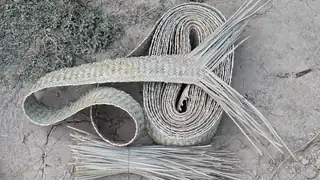
The leaf is the most visible palmyra product. Young, pale leaves are cut, sun-dried and split into strips, then plaited by hand into sleeping and sitting mats, baskets, boxes, hand fans and small decorative items. The best-known is the panai olai paai, the traditional South Indian floor and sleeping mat. If you want to know how a mat is made, our article on palm leaf mat weaving walks through each step.
Older, tougher leaves are used whole for thatching roofs, fencing, shade screens and temporary shelters, especially in rural areas.
Palm leaves also have a place in history. For centuries, treated palm leaves were used as writing material in South India and other parts of Asia. Texts were incised on the leaf and the lines were then darkened. These palm-leaf manuscripts, olai chuvadi in Tamil, preserved literature, records and knowledge, and many are still kept in libraries and museums.
Leaf ribs: brooms
Each segment of the palmyra leaf has a stiff rib. Collected, cleaned, dried and tied together, these ribs make the panai eeki broom. It is thicker and stiffer than a coconut stick broom, so it is used for rough and outdoor sweeping: yards, mills, godowns, roads and cattle sheds. Our palmyra brooms are about 85–105 cm long and about 500–750 g each, double-tied so the ribs stay in.
The palmyra yields fibre, especially from the base of the leaf stalks. Traditionally it has gone into brushes, brooms and rope. Palmyra fibre rope (panai naar kayiru) is twisted by hand and grips knots well, which is why farmers use it for staking and tying. Our article on what palmyra fibre is and how it is used covers fibre in detail.
We supply palmyra fibre rope in 2-ply (about 6–10 mm) and 3-ply (about 10–14 mm), in 25 kg and 50 kg coils. It is agricultural rope for tying and bundling only, not for lifting, hoisting or climbing.
Fruit: nungu, ripe fruit and the palm sprout
The female palmyra bears clusters of round, dark fruits. Picked young, each fruit holds soft, translucent, jelly-like kernels called nungu, sold in English as ice apple or palm fruit. In Tamil Nadu, nungu is a familiar summer sight at roadside stalls.
When the fruit is left to ripen, its fibrous orange pulp, panam pazham, is eaten, often after roasting. Seeds planted in the ground sprout into long shoots called panangkizhangu, which are boiled or roasted and sold in markets. We do not deal in any of these food products; we mention them because they are part of the palmyra’s story.
Sap: neera and palm jaggery
Skilled climbers tap the flower stalks of the palmyra to collect sap. The fresh, sweet sap is known as padaneer in Tamil and neera more widely. It ferments quickly, so it is drunk fresh or processed soon after collection. Boiled down, the sap becomes palm jaggery, called karupatti, and it is also made into palm sugar candy (panangkalkandu). Palmyra climbing and tapping are seasonal, skilled and physically demanding work.
We describe these food products only to explain the tree. We do not sell them, and we make no claims about them.
Trunk: timber
The trunk of a mature palmyra is hard and heavy on the outside. In traditional houses in palmyra areas, split palmyra trunks have been used as rafters, beams and posts. Old trees that are no longer productive are a common source of this timber.
04
Palmyra palm vs coconut palm: a quick comparison
Buyers outside Tamil Nadu often mix up the two palms, and their products. Both grow in our district, and we supply products from both, so here is a short comparison.
Feature
Palmyra palm (panai)
Coconut palm (thennai)
Leaf shape
Fan-shaped, stiff
Long, feather-like
Where it grows best
Dry, hot areas; sandy soil; little care
Coastal and irrigated areas; needs more water
Main fruit
Nungu (young), panam pazham (ripe)
Tender coconut and mature coconut
Broom
Panai eeki: thick, stiff ribs for rough and outdoor sweeping
Thenna eeki: thinner, flexible midribs for everyday sweeping
Leaf weaving
Fine mats, baskets, fans
Mostly coarse thatch panels and screens
Fibre
Leaf-stalk fibre for rope and brushes
Coir from the husk for rope and mats
What we supply
Mats, palmyra brooms, palmyra rope
Coconut leaf brooms, mature coconuts
So when a customer asks for a “palm broom” or a “palm mat”, it is worth checking which palm they mean. A palm leaf sleeping mat in Tamil Nadu is almost always palmyra. A stick broom sold in most provision stores is usually coconut. If you are deciding which brooms to stock, our coconut broom vs grass broom guide covers the everyday options, and we also supply coconut leaf brooms alongside palmyra products in the same pickup.
Palmyra work is mostly hand work. Climbing the tree to cut leaves or tap sap, drying and splitting leaf, plaiting mats, cleaning and tying ribs, and twisting fibre into rope are all skills learned over years, usually within families in palmyra villages. The work is seasonal too: leaf, rib and fibre supply changes through the year, which is one reason the rate and ready time of palmyra products can vary by season. Palmyra rib supply for brooms, for example, is generally best from February to September. When you buy palmyra products in bulk, you are buying the output of this village work, which is also why small differences between pieces are normal.
Looking for palmyra products in bulk?
We supply handwoven palm leaf mats, palmyra brooms and palmyra fibre rope wholesale from MPK Valasai, Ramanathapuram. Ask for the current godown rate.
Not every palmyra product is a good fit for wholesale trade. Food items like nungu and neera are perishable and are sold fresh and locally. Craft products are different: they are dry, light and keep well if stored properly, so they travel well to shops in other cities and states.
Palmyra mats, brooms and rope are plant material. They contain no plastic, and when they are finally worn out they break down as plant material rather than staying as plastic waste. That is a real and simple point, and it is enough. We avoid bigger claims we cannot measure, and we recommend our buyers do the same when they sell. Our article on eco friendly mats has tips on describing natural products honestly.
Natural products also need natural care. Palm leaf, ribs and fibre do not like long periods of damp. Store them dry, ventilated and off the floor, as explained in our storage guide.
08
How to order palmyra products from Ramnad Agro
Send your enquiry with the product, size and quantity through our quote form or WhatsApp. You can combine mats, brooms and rope in one pickup.
Pay 50% advance to book the order. Samples can be couriered at cost.
Arrange your transport. We sell ex-godown only: you book and pay for the lorry, mini-truck or transport company. Our guide on arranging transport from a Tamil Nadu supplier helps first-time buyers.
Book a loading slot on the pickup booking form, pay the balance before loading, and our team packs and loads free, 6 AM to 8 PM, seven days a week.
Stock palmyra products from the palmyra belt
Mats, brooms and rope from Ramanathapuram, packed and loaded free at our godown in MPK Valasai. Tell us what you need and we will reply with the current rate and a ready date.
The palmyra is a tall fan palm, botanically Borassus flabellifer, known in Tamil as panai maram. It grows widely in South Asia and is the state tree of Tamil Nadu. It has a straight, unbranched trunk and a crown of large fan-shaped leaves.
What are the main uses of the palmyra tree?
Leaves are woven into mats, baskets and fans and used for thatch; leaf ribs and fibre go into brooms, brushes and rope; the young fruit is eaten as nungu (ice apple); the sap is collected as neera and boiled into palm jaggery (karupatti); and the trunk has been used as timber in traditional buildings.
Is the palmyra palm the same as the coconut palm?
No. Both are palms, but the palmyra has fan-shaped leaves and the coconut has long feather-like leaves. Their fruits, fibres and uses are different. A palmyra broom is made from palmyra leaf ribs, and a coconut broom from coconut leaf midribs.
Why are there so many palmyra trees in Ramanathapuram?
The palmyra is hardy and grows well in dry, hot areas with sandy soil, conditions found across much of southern coastal Tamil Nadu, including Ramanathapuram. Many palmyra trees there also grow on field boundaries and common land.
Which palmyra products does Ramnad Agro supply?
We supply handwoven palm leaf mats (panai olai paai), palmyra brooms (panai eeki) and palmyra fibre rope (panai naar kayiru) wholesale, ex-godown from MPK Valasai. We do not sell nungu, neera, karupatti or palmyra timber.
Were palm leaves used for writing?
Yes. For centuries, treated palm leaves were used as writing material in South India and other parts of Asia. Palm-leaf manuscripts, called olai chuvadi in Tamil, preserved many texts, and libraries and museums still hold large collections of them.
Buying palm leaf mats in bulk for a resort, homestay or yoga centre? Sizes, uses, care, replacement planning and how to order and collect from the godown.
Need today's wholesale price?
Send the product, quantity and your city. We reply with the price at our godown, usually the same day. You arrange the transport; we pack and load it free.