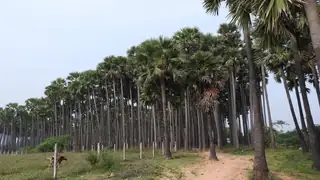
Most buyers see a palm leaf mat only when it is finished, rolled and tied in a bundle. But palm leaf mat weaving is a long chain of hand work, and every link in that chain shows up in the mat you sell. If you know how a mat is made, you can judge a sample in two minutes, explain the product to your customers, and avoid stock that will come back with complaints.
I am Gokul from Ramnad Agro, a family wholesale business in MPK Valasai, Ramanathapuram, started in 1998 by my father, Mr. Chokkalingam. Ramanathapuram is one of Tamil Nadu’s palmyra belts, and the palm leaf mats we supply are woven by hand by village makers in the district. This guide walks through the process from leaf to finished mat, in plain terms, and then shows you what to check when you buy.
01
What is a palm leaf woven mat?
In South India, a palm leaf woven mat usually means a mat plaited from the leaf of the palmyra palm (Borassus flabellifer), the state tree of Tamil Nadu. In Tamil it is called panai olai paai: panai is palmyra, olai is leaf, and paai is mat. It is different from a korai mat, which is woven from sedge grass, and from a coconut leaf mat, which is coarser and mostly used for thatch and screens. Our palm leaf mat vs korai mat guide explains that difference in detail.
The palmyra leaf is fan-shaped, with many long, narrow segments joined at the base. Those segments are what weavers turn into strips. There is no loom, no machine and no glue. The mat is held together only by the way the strips cross over and under each other and by how the edges are folded in.
02
The weaving process, step by step
Practices vary from village to village and from family to family, but the main steps are the same. Here is the process, and what each step means for the quality you see as a buyer.
Step 1: Cutting young leaves
Mat leaf comes from the young leaves near the crown of the palmyra, before they are fully hard and dark green. Young leaf is paler and more pliable, so it can be split into thin strips and bent without cracking. Climbing a palmyra is skilled, physical work, and leaf is cut by people who know the trees.
What it means for you: leaf that is too old makes a stiff, brittle mat that cracks when rolled. Leaf from the right stage makes a mat that rolls smoothly and lies flat.
Step 2: Drying and seasoning in the sun
The cut leaf segments are separated, the stiff midrib of each segment is removed, and the leaf is spread out to dry in the sun. As it dries, the green colour fades towards the pale straw colour buyers know. The dry, sunny weather of Ramanathapuram helps here, but drying still needs care: leaf has to be turned, kept off wet ground and brought in if rain threatens.
What it means for you: this is the step that decides mould risk. Leaf that is not fully dried before weaving, or a mat that gets damp after weaving, can develop dark spots and a musty smell later, often after it has reached your shop. A well-dried mat smells of dry leaf and nothing else.
Step 3: Splitting into strips
The dried leaf is split lengthwise into strips of the width the weaver wants. Narrow strips give a finer, tighter-looking weave and take more time; wider strips weave faster and give a coarser look. Many weavers soften the dry strips slightly with a little water before plaiting, so they bend without breaking.
What it means for you: strips of even width give an even, regular pattern. Strips cut unevenly give a patchy weave with small gaps. This is one of the clearest signs of careful work.
Step 4: Dyeing (where it is done)
Some weaving traditions dye a share of the strips to weave coloured borders or patterns. Our mats are not dyed. We supply plain mats woven from unbleached, sun-dried leaf with no chemical dyes, in the natural colour of the leaf. If a buyer asks for coloured mats, that is a different product from a different kind of maker.
What it means for you: a plain natural mat varies a little in shade from mat to mat, because each leaf dries a little differently. That variation is normal and is part of what you are selling.
Step 5: Plaiting the body of the mat
The weaver lays out strips and plaits them by hand, each strip crossing over and under the strips that run the other way. The weaver keeps pressing the plait tight as the mat grows. There is no frame to keep the shape square; the weaver’s hands and eye do that work. This is the longest part of the job.
What it means for you: a tight, even plait gives a mat that feels firm, does not show gaps when held up to light, and keeps its shape. A loose plait feels soft and floppy, opens up at the crossings and wears out quickly.
Step 6: Edging and finishing
When the body reaches the right size, the strip ends at each side are folded back and woven into the mat, so there are no cut ends sticking out. Our standard mats have folded, double-woven edges. Stray ends are trimmed, and the mat is checked for loose strips.
What it means for you: the edge is where a mat wears first. A firmly folded edge holds up to rolling and everyday use. A weak edge starts to unravel early, and a mat with fraying edges is hard to sell.
Step 7: Sizing, drying again and bundling
Finished mats are checked for size, given a final airing so they are fully dry, rolled and tied. At our godown, we check each mat for an even weave, firmly finished edges, full dryness and the right size before we pack them in bundles of 25, compressed and wrapped in gunny or hessian.
| Step | What happens | What the buyer sees in the finished mat |
|---|
| Cutting | Young palmyra leaves are cut from the crown | Pliable mat that rolls without cracking |
| Drying | Leaf segments separated, midribs removed, sun-dried | Straw colour; no mould spots or musty smell |
| Splitting | Dry leaf split into strips of even width | Regular pattern without gaps |
| Dyeing | Not done for our mats | Natural colour, slight shade differences |
| Plaiting | Strips plaited by hand and pressed tight | Firm feel; lies flat; no gaps at crossings |
| Edging | Strip ends folded back and woven in | Straight, strong edges with no loose ends |
| Sizing and packing | Checked, aired, rolled and bundled | Correct size; arrives dry and clean |
03
How to weave palm leaves: is it something a buyer should try?
Many people search for how to weave palm leaves or how to make a mat with palm tree leaves at home. Simple plaiting can be learned, and small items such as hand fans and small baskets are a common starting point. But a full sleeping mat with tight, even plaits and strong edges takes years of practice. In palmyra areas, the skill is usually learned at home, by watching and helping older family members.
For a shop or reseller, the useful point is this: the quality of a mat depends far more on the weaver’s skill and patience than on the raw leaf. That is why mats from the same district can differ, and why it pays to check a sample and buy from a supplier who checks each mat.
04
How to spot good weaving: a buyer’s checklist
Use this checklist on a sample, and spot-check a few mats from each bundle when your stock arrives.
- Unroll it on a flat floor. A well-woven mat lies flat, without big waves or a twisted shape.
- Hold it up to the light. Small points of light at the crossings are normal; clear gaps or open patches are not.
- Run your hand over the surface. It should feel even and firm, with no strips sticking up.
- Check all four edges. Edges should be straight, folded and firmly finished, with no cut ends or unravelling.
- Look for loose or broken strips in the body of the mat, especially near the edges and corners.
- Check the colour. A natural straw colour with slight shade differences is normal. Dark patches or spots can mean damp.
- Smell it. A dry mat smells of dry leaf. A musty or sour smell means it has been damp and may develop mould.
- Measure it. Handwoven sizes are approximate, but a mat sold as about 6×3 ft should be close to that.
- Roll it back up. It should roll smoothly without cracking. Cracking can mean over-dry, brittle or old leaf.
| What you notice | Normal for a handmade mat? | What to do |
|---|
| Slight shade difference between mats | Yes | Mention natural variation to your customers |
| Size a little off the nominal size | Yes, within reason | Describe sizes as approximate |
| Clear gaps or loose plait | No | Raise it with the supplier |
| Loose ends or unravelling edges | No | Set aside; raise it with the supplier |
| Dark spots or musty smell | No | Separate from dry stock; air it; check your storage |
| Cracks when rolled | No | Check whether the mat was folded or stored too long in heat |
05
After weaving: keeping the quality you paid for
A well-woven mat can still be spoiled by poor handling. The two big risks are damp and folding. Keep bundles in a dry, ventilated place, off the floor, and never seal a damp mat in plastic. Roll mats; do not fold them, because repeated folding cracks the strips. Our guide on how to store palm leaf mats, brooms and rope without mould covers this step by step.
When you describe mats to your own customers, the weaving story is your best selling point. Say plainly that each mat is woven by hand from natural palmyra leaf, that sizes are approximate, and that small differences between mats are normal. If you sell online, our guide to selling palm leaf mats online shows how to photograph the weave and edges.
06
Sizes and ordering
We supply two standard sizes: about 6×3 ft (about 1.2–1.8 kg per mat) for sleeping and floor seating, and about 4×2 ft for sitting, pooja, dining and yoga. Custom sizes can be made for bulk orders on request. The full details are in our sizes, packing and MOQ guide, and how the rate is worked out is explained in our palm leaf mat price guide.
- Send your enquiry with sizes and quantity through the quote form or WhatsApp.
- Check a sample if you want, couriered at cost.
- Pay 50% advance to book. Stock orders of 50–300 mats are usually ready in about 3 business days; larger orders run on a booked schedule.
- Book your transport and a loading slot on our pickup booking form. We sell ex-godown only, so you arrange and pay for the vehicle.
- Pay the balance before loading. Our team packs and loads free at MPK Valasai, 6 AM to 8 PM, all seven days. The Delivery & Pickup page has the address and directions.