
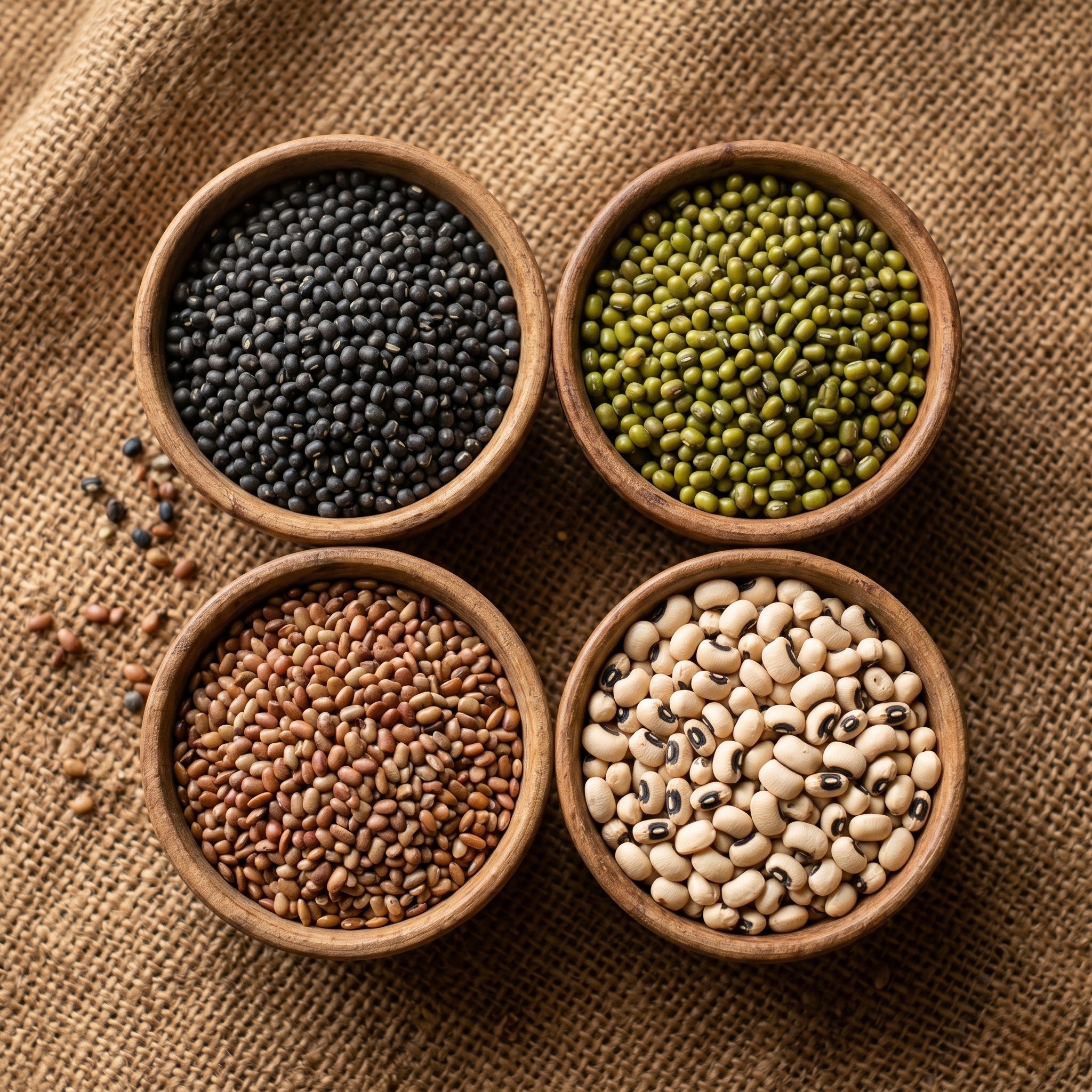
Ten years ago, if you walked into a city supermarket in Chennai or Madurai looking for Kollu (horse gram), you would have struggled. Most retail chains stocked the same four pulses — toor dal, moong dal, urad dal, chana dal — and that was the entire offering. Native varieties survived only in village markets and small Ayurvedic shops.
That market has flipped completely in the last five years. Today, native pulses are among the fastest-moving categories in organic and health-focused retail. Kollu sells for two to three times the price of the same weight of toor dal. Thatta Payir (cow pea) has become a regular feature in upscale restaurants. And the demand is growing faster than most regional wholesalers can supply.
For anyone in the wholesale trade — retailers, distributors, food manufacturers — understanding this shift is no longer optional. Here's what's happening and how to position for it.
The three forces driving the comeback
1. The health and Ayurveda movement
Indian consumers, especially in tier-1 and tier-2 cities, have rediscovered traditional foods through the wellness and Ayurveda movement. Kollu is now well-known for its role in weight management and metabolism. Thatta Payir is recognised for its protein density. Naattu Kadalai (native chickpea) is being marketed as a low-glycemic alternative to white chickpea.
Each of these claims has roots in traditional Siddha and Ayurvedic texts that have been around for centuries. What changed is that urban consumers now read about them on Instagram and YouTube, and ask for them by name.
2. The climate angle
Native pulses are dramatically more drought-resistant than mainstream varieties. Kollu, for example, thrives on poor soils and minimal rainfall — exactly the conditions of Ramanathapuram and other dry districts in southern Tamil Nadu. As climate variability increases, native pulses are also returning to favour with farmers who can't afford water-intensive crops.
This creates a positive supply-demand loop: more farmers are willing to grow them again because demand is rising, and supply is finally catching up to interest.
3. The story economy
Modern retail isn't just about the product — it's about the story behind it. Native pulses come with a built-in story: regional heritage, traditional farming, climate resilience, family recipes. Brands and retailers are willing to pay a premium for products that carry these stories naturally. That premium flows back through the supply chain to wholesalers and farmers.
Which native pulses are moving fastest
Based on what we see in our wholesale orders and conversations with buyers, here's the rough demand ranking among native pulses from the Ramnad region:
| Pulse | Tamil Name | Demand Level | Best Buyer Segment |
|---|---|---|---|
| Horse Gram | Kollu | Very High | Health stores, urban retail |
| Cow Pea | Thatta Payir | High | Restaurants, retail |
| Black Urad | Karuppu Ulundhu | High | Restaurants, food manufacturers |
| Moong Dal (native) | Naattu Pasi Payir | Medium-High | Retail, organic stores |
| Native Chickpea | Naattu Kadalai | Medium | Health-focused retail |
What wholesalers should think about
Sourcing reliability beats price
Native pulses come from smaller acreage and unpredictable harvests. A buyer who pays a slightly higher price for guaranteed monthly supply will outperform a buyer chasing the lowest cents per kilo from a different farm every month. Build supply relationships, not transactional purchases.
Unpolished is a feature, not a flaw
Wholesale buyers used to grade pulses by visual uniformity — bright colour, polished appearance. The new urban buyer wants the opposite: dull, unpolished, slightly irregular. That's the visual signal that the pulse hasn't been chemically treated. Adjust your sourcing standards accordingly.
The 50 kg sack is now a small order
Five years ago, a 50 kg sack of Kollu was a "big" purchase for a city retailer. Today, mid-tier organic chains are placing standing orders of 500–1000 kg per month. The MOQ economics have completely shifted for anyone serious about this segment.
A note on quality
Native pulses are also more prone to adulteration than mainstream varieties — exactly because their visual signals (uneven colour, slightly different shapes) are easier to fake. The simplest protection: source from a wholesaler who can point to the village and the farmer. If your supply chain is opaque, the risk is yours.