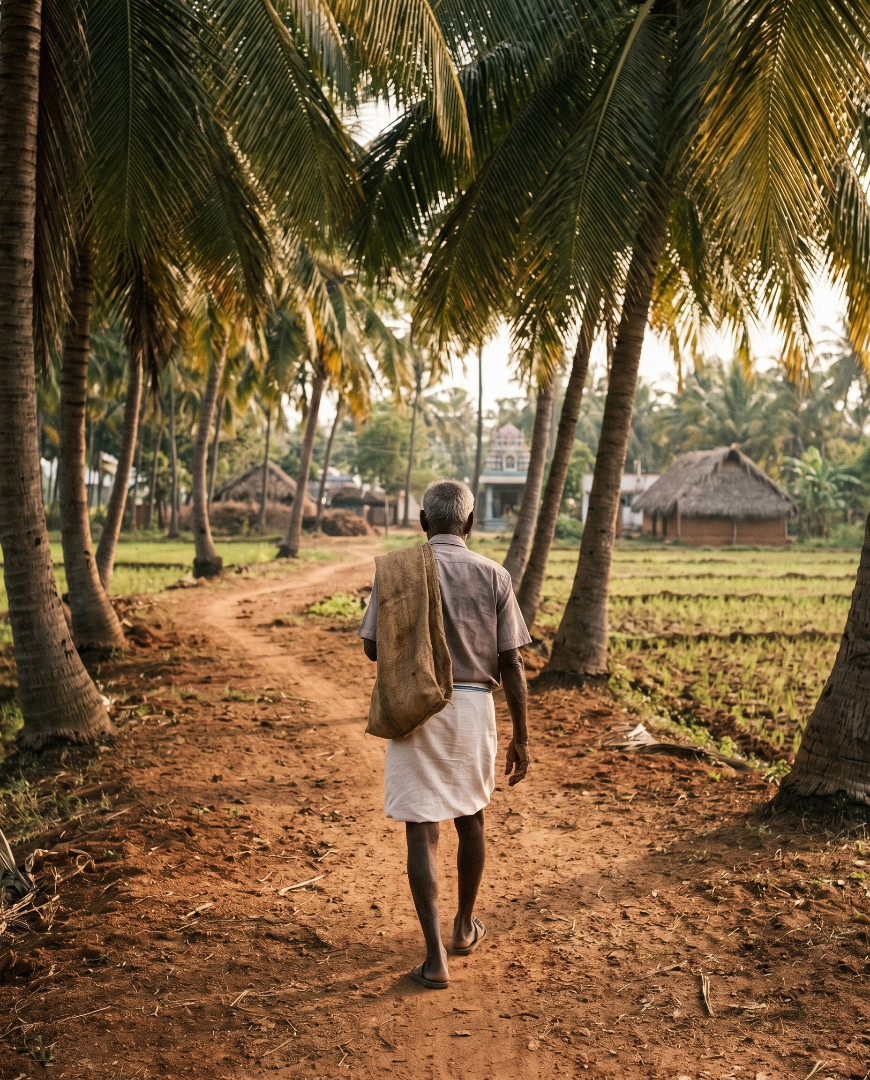
It is 5:30 in the morning in MPK Valasai. The sky over the coconut palms is starting to lighten, and the first sounds of the village are the rhythmic chops of a dehusking knife and the call of a vendor passing through with hot tea. By the time most of urban India wakes up, the working day in this corner of Ramanathapuram is already two hours old.
This article is for buyers who have asked us, over many calls, what our village is actually like. We hope it helps you picture where your wholesale order comes from — and the people who make sure it gets to you.
The land
MPK Valasai sits in the dry agricultural belt of Ramanathapuram district, in southern Tamil Nadu. The soil is a mix of red earth and sandy patches, and the rainfall is moderate — kind to plants that can manage with what they get. That makes it ideal country for coconut palms, palmyra, neem, and tamarind trees, all of which have grown here for generations.
The village itself is small — a few hundred families, spread across an area defined more by farmland than by streets. Walk from one end to the other and you'll pass coconut groves, a tank where buffaloes are bathed, palmyra trees lining the field boundaries, and small homes with thatched verandas where women weave palm leaf mats in the cool morning hours.
The morning at our godown
Our godown is on the village's edge, attached to the original Gokul Stores my father started in 1998. By 6 AM, the first truck of coconuts arrives — usually from one of the farms within a five-kilometre radius. The farmer's helper unloads, our staff weighs each lot, and within an hour the coconuts are stacked in our central yard ready for dehusking.
Dehusking is still mostly done by hand here. A team of three workers can process about 800–1000 coconuts in a morning, and they have been doing this for more than a decade each. There is a rhythm to it — one strike to crack the husk, two more to peel it cleanly, then toss the husked coconut into a waiting sack. The husks themselves go into a separate pile that gets sold to coir-fibre mills.
Sorting and quality check
After dehusking, every coconut passes through a sort. Mature coconuts for oil milling go in one stack, smaller or younger nuts go to another buyer category, and any that show signs of damage or fungal spot are rejected outright. This is the step that has always been non-negotiable for us — the moment we let a bad coconut into a bulk shipment, we lose the buyer for life. Our quality reputation is built on this single sorting yard.
The artisans behind the brooms and mats
While the dehusking is happening, in a different corner of the village, the broom-makers are at work. Coconut leaf brooms (thenna eeki) and palmyra brooms (panai eeki) are mostly made by the women of the village. They strip the leaves, dry the midribs, and bundle them by hand — usually working in small groups under a thatched canopy.
A skilled broom-maker can produce around fifteen finished brooms in a few hours. The same hands that make brooms in the morning are often weaving palm leaf mats in the afternoon. It's a complete cottage industry, and an important part of the village economy. When you place an order with us, you're not just buying a product — you're sustaining a craft that has been in this region for generations.
Loading the lorry
By late afternoon, a typical lorry order is ready to be loaded. The driver and his cleaner help our workers stack sacks of coconut or bundled mats and brooms into the truck. There's a routine to it that has been refined over the years. The lorry leaves before sunset, heading for Madurai, Trichy, or further into the state.
What buyers at the receiving end see is a clean, well-packed delivery. What they don't always see is the chain of small, careful steps that produced it — the farmer who chose to harvest at the right maturity, the dehusker who knew which nuts to reject, the sorter who didn't let a single bad one slip into the sack.
What this place taught us
The phrase we use on our website — "we are not corporate brokers operating from a distant city" — isn't marketing. It's just a description of where we work. Every coconut, every bundle, every kilo of pulses passes through hands we know personally, in a village that has been our home for two generations.
If you buy in bulk from us, you're welcome to visit. Most of our long-term buyers have, at least once. Standing in the dehusking yard at 7 AM, watching the sun come up over a stack of coconuts, is the best quality control you'll ever do.